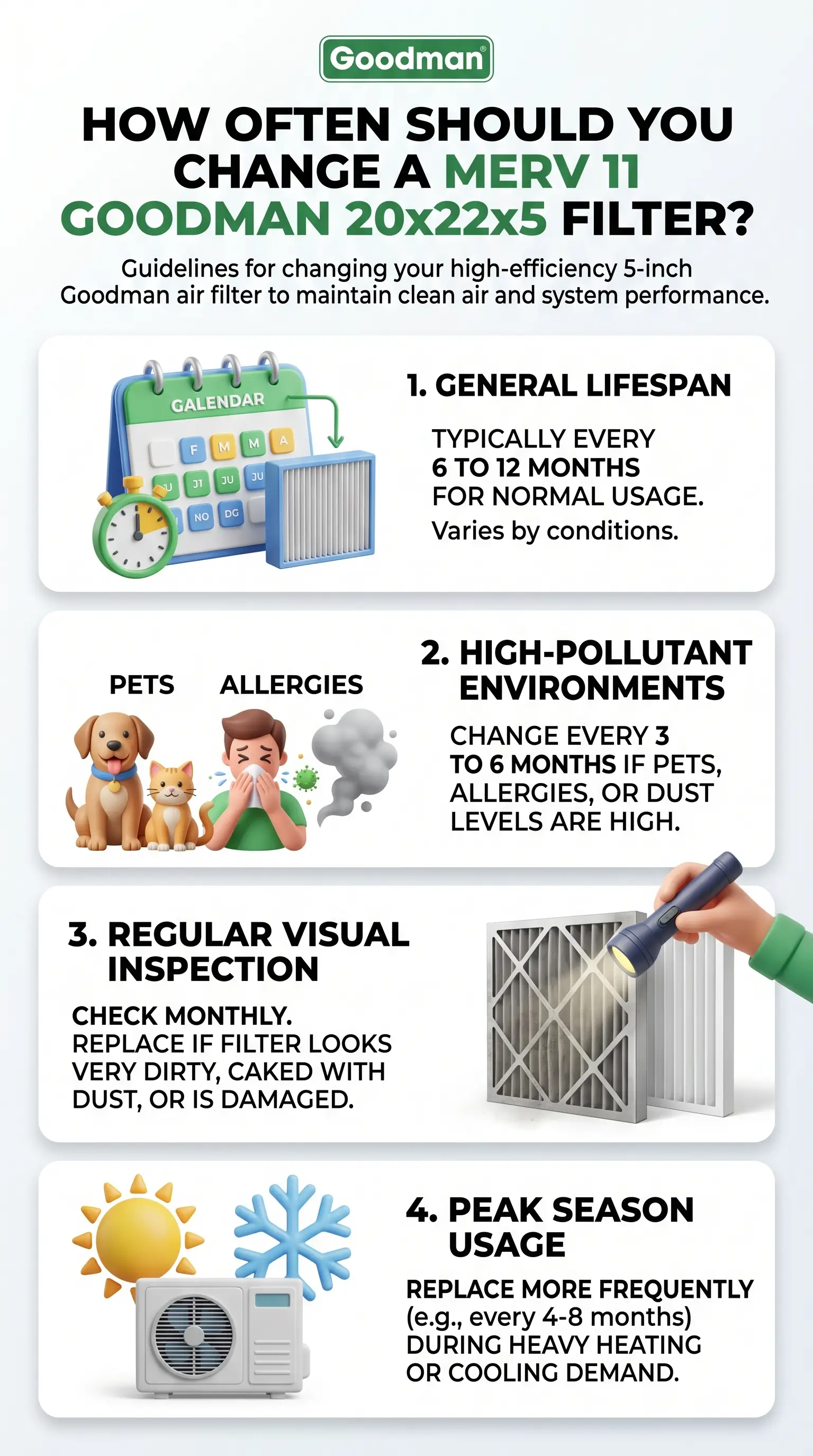
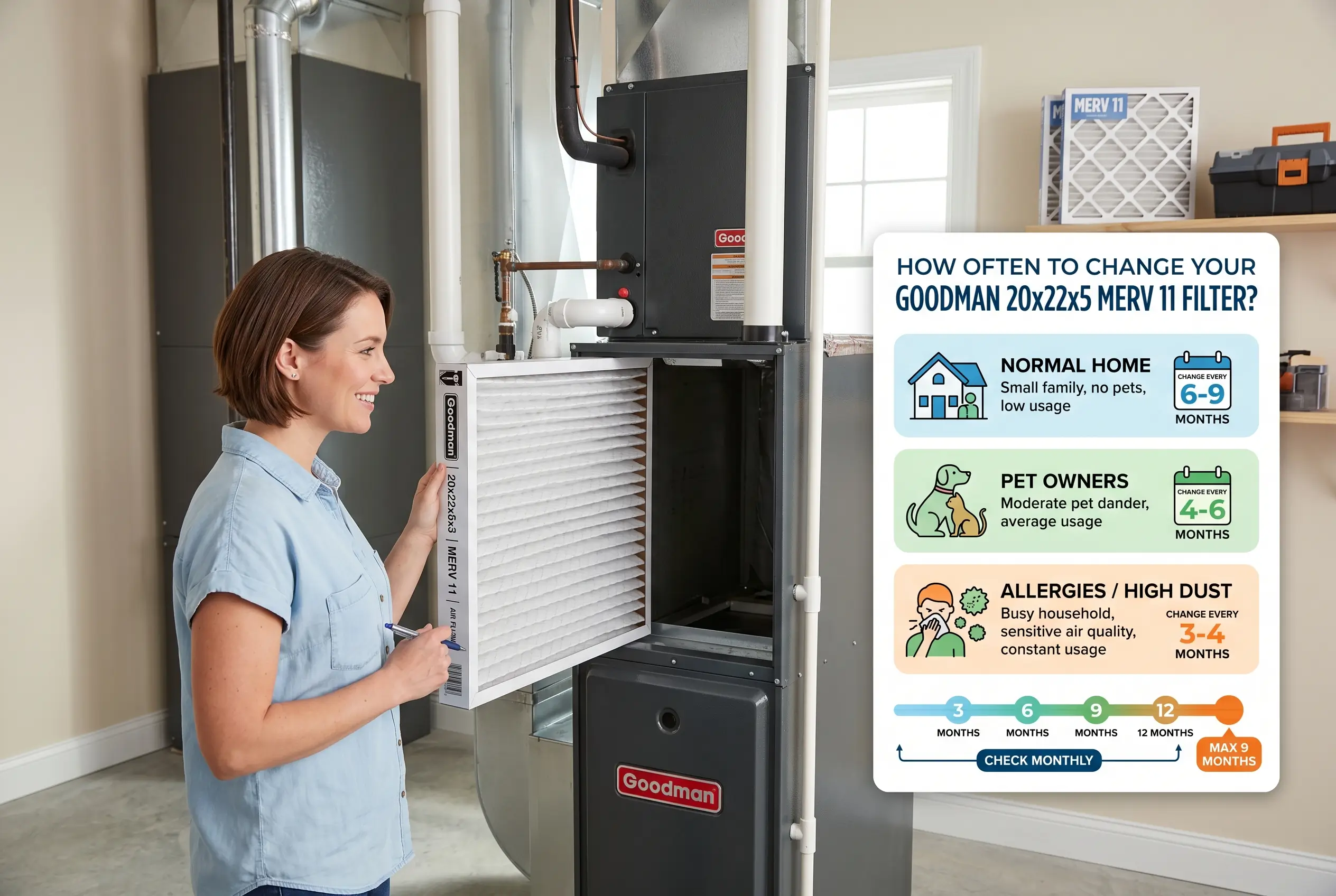
I spend a strange amount of time thinking about what is floating through other people’s houses. A loaded filter is where that invisible stuff finally shows itself. Pull a five-inch filter that has gone too long and you can read months of a home’s history in the gray packed deep in its pleats, the dust and pollen and pet dander that would otherwise keep circulating past everyone who lives there. For a MERV 11 in the 20x22x5 size, my answer is short. Plan on six months, then let your own home move that date earlier or later.
Checking beats guessing every time, and that one habit has saved the people I help more service calls than any premium upgrade ever has. I tell them to keep a couple of Goodman 20x22x5 air filters on hand so a swap never waits on a shopping trip.
TL;DR Quick Answers
- Baseline: about every six months.
- Pets or allergies in the house: every three to four months to reduce circulating allergens when sensitivity runs highest.
- Dusty, high-pollen, or always-running homes: every two to four months.
- No matter the number: check it monthly and replace it once light barely passes through the pleats.
- Buy by the nominal size printed on your current filter, not the smaller measured size.
Top Takeaways
- A MERV 11 in this size runs about six months for most homes.
- The five-inch depth holds far more than a one-inch panel, which helps keep airflow steady between changes.
- Pets, allergies, runtime, renovation, and pollen all pull that interval shorter.
- Treat the printed 90-day number as the day to start checking, not a hard deadline.
- A ten-second look at the pleats against a light beats any reminder on your phone.
Why five inches changes the math
Depth is the whole story with a 20x22x5. The labeled size rounds up. The filter actually measures close to 19.56 by 22 by 5.25 inches, and that thickness buys it far more surface area than a flat one-inch panel. More surface means more room to hold dust before airflow starts to choke, which is why a five-inch media filter outlasts the thin panel you swap every month or two to capture everyday household particles. A home that chews through one-inch filters in 30 to 45 days can usually run a five-inch for several months and never notice a problem.
What MERV 11 adds
MERV is shorthand for how small a particle a filter can grab. An air filter at MERV 11 sits in the sweet spot most homes want. It pulls down the fine dust, pollen, pet dander, and mold spores that a basic MERV 8 waves right through, and it does that without strangling airflow the way the densest filters can. The catch is honest. A filter that catches more also fills up faster in a dusty house, so the rating that cleans your air better can shorten the time between changes.
What actually sets your interval
The box gives you a starting point. Your house writes the real schedule. Here is what I weigh every time:
- Pets: fur and dander load a filter fast, so a fresh one helps trap more airborne dust and takes a month or more off the interval.
- Allergies or asthma at home: change earlier, because that is exactly when high capture earns its keep.
- A full house and a system that runs all day: more bodies and more runtime push more air, and more particles, through the filter, which is part of why expert system installation and right-sizing matter in the first place.
- New construction or a recent remodel: drywall dust and sanding grit can cut a filter’s life in half.
- Season: a wave of pollen or a stretch of wildfire smoke can pack a filter in weeks, so a fresh one helps cut down on household dust when the outdoor air is at its worst.
Box says 90 days, media guides say longer. Which is right?
This is where people get stuck. The box prints 90 days. Plenty of guides say a five-inch media filter can stretch to six or even twelve months, and both are telling the truth. Ninety days is the safe floor, and the longer range assumes a light, clean home that mine and yours may not be. So I split the difference with judgment instead of faith. I treat the printed number as the earliest I would bother checking and the long end as the most I would ever push it, then I let the filter cast the deciding vote. If fewer trips to the store sound good, some homeowners step up to washable options for long-term filter savings, as long as they actually rinse them on schedule.
How to tell without a calendar
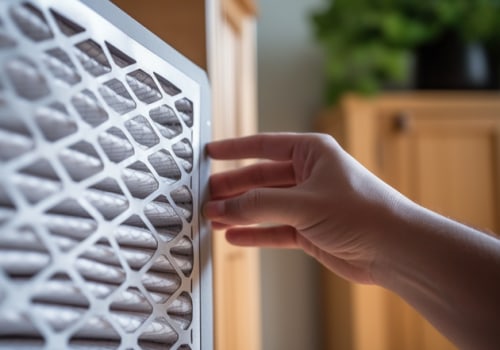
Pull the filter and hold it up to a light. If the light barely gets through the pleats, it is done, whatever the date says. The other tells are just as plain: soft air at the registers, a thin film of dust returning to surfaces you just cleaned, and a system that runs longer to reach the same temperature. The whole check takes about ten seconds, and it turns a guessing game into a glance.
“In two decades under houses and up in attics, I have never once seen a calendar beat a thirty-second look at the filter. Set the six-month reminder for a five-inch, then trust your eyes over the date.”
7 Trusted Resources for Filter Owners
Every link below is a non-commercial source, and no two share a domain:
- EPA Guide to Air Cleaners in the Home: how to pick and look after HVAC filters and portable cleaners.
- U.S. Department of Energy: Air Conditioner Maintenance: what a dirty filter costs you in efficiency.
- ENERGY STAR: Heat and Cool Efficiently: the monthly check-and-change habit, kept simple.
- CDC NIOSH: Improving Air Cleanliness: filter fit, sizing, and service life.
- American Lung Association: Air Cleaning: where HVAC filtration sits in your home’s air quality.
- NAFA: Understanding MERV: what the rating numbers really mean.
- CPSC: The Inside Story, A Guide to Indoor Air Quality: the plain basics of indoor pollutants.
3 Numbers That Put Filter Timing in Perspective
- We spend roughly 90 percent of our lives indoors, where some pollutant levels run two to five times what they are outside. That is a lot of breathing through whatever your filter catches, or misses. (EPA, Indoor Air Quality)
- A clogged filter drags down airflow and efficiency and pushes energy use up, which is why federal guidance says to check and clean or swap filters every month or two through the cooling season. (U.S. Department of Energy)
- MERV runs on a scale of 1 to 16, and the higher you climb, the more of the fine particles that hang in indoor air the filter pulls down. (CDC NIOSH)
Where I Land on This
If you want one answer, here it is. Set a six-month reminder for a MERV 11 this size, then let a monthly glance pull the date in when your home asks for it. Pets, allergies, heavy runtime, or a recent remodel all point to three or four months. The same care you would put into choosing the right insulation for your attic pays off when you give the filter a regular look, because both are quiet jobs that protect the people under your roof. I would rather change a filter a few weeks early than make the blower fight a clogged one, and when a fresh filter still does not bring the airflow back, the real culprit may be a tired unit closer to replacing an aging system than to another swap. After enough years of pulling these, I will say it plainly: the early check is the closest thing to a free upgrade I know.
Frequently Asked Questions
How long does a MERV 11 Goodman 20x22x5 filter usually last?
About six months in an average home, less with pets, allergies, or heavy use, and a little more in a light, clean one. Check it monthly and let its condition do the talking, since staying on schedule is the simplest way to keep your indoor air cleaner.
What is the actual size of a 20x22x5 filter?
The label gives you the nominal size. The real measurements come in close to 19.56 by 22 by 5.25 inches, which is normal for this class of filter. Reorder by the nominal number on your old one, because a snug fit is the first step in caring for a high-efficiency filter, since air that sneaks around the frame never gets cleaned.
Is MERV 11 too restrictive for my system?
For most homes built to take a five-inch media filter, MERV 11 lands right in the comfortable middle of capture and airflow. If you are not sure, check the owner’s manual for the highest rating your blower can pull, and it helps to know how MERV ratings work before you step up.
Can I leave a five-inch filter in for a full year?
You can. I would not bank on it. A year is the far edge, and only for the lightest, cleanest homes. Most load up well before then, and a filter pushed too long strains the system and lets more particles slip back into the air, which is part of why cleaning out your ductwork now and then helps.
How do I know it is time to change it without tracking dates?
Hold it to a light. If you can barely see through the pleats, replace it. Weak airflow, a faster return of dust to clean surfaces, and longer run times all say the same thing, and if a fresh filter does not bring the airflow back, sealing leaky ducts is worth a look.
Keep Your Air Moving Cleanly
Take ten seconds to pull your filter and hold it up to a light, then set a reminder for the next look. A clean filter is the simplest way to protect the air your family breathes and the system that moves it, and a properly installed system gives that filter the airflow it needs to do its job.
Learn more about HVAC Care from one of our HVAC solutions branches…
Filterbuy HVAC Solutions - Miami FL - Air Conditioning Service
1300 S Miami Ave Apt 4806 Miami FL 33130
(305) 306-5027
https://maps.app.goo.gl/Ci1vrL596LhvXKU79